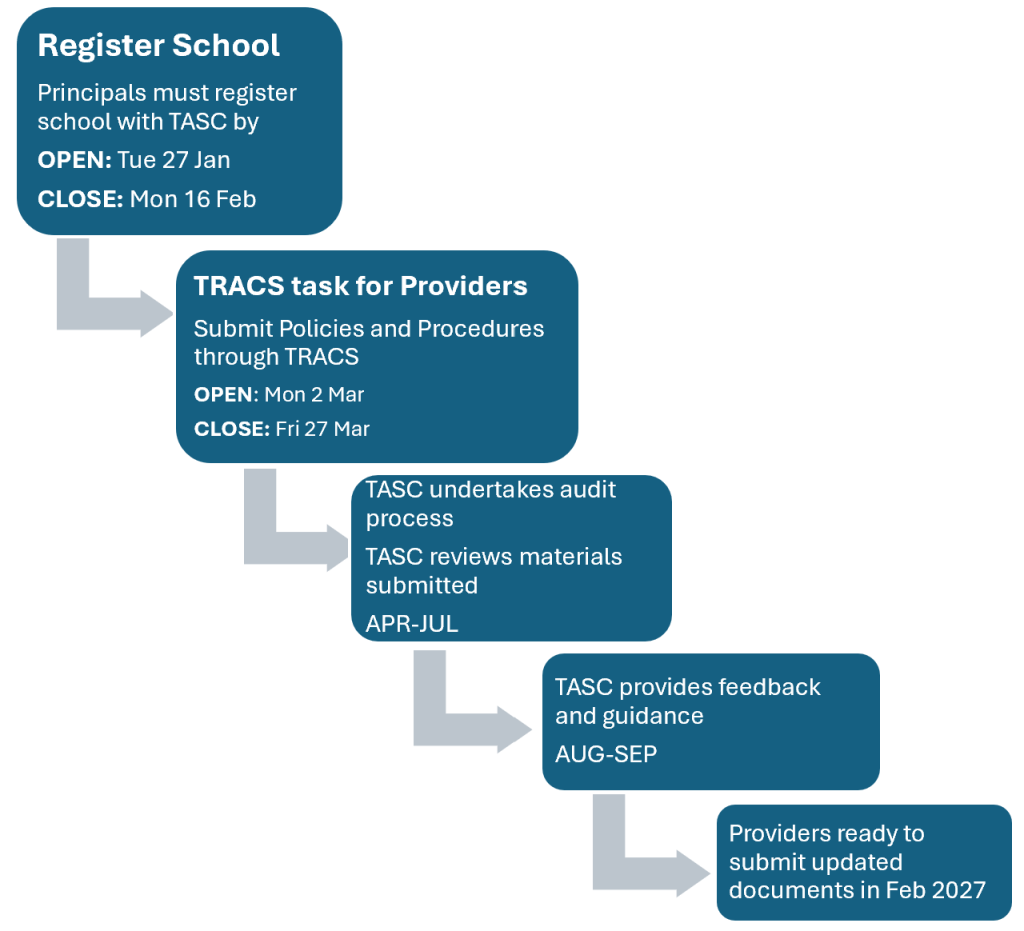
Desktop audits
Purpose: Desktop audits examine submitted documentation to confirm alignment with TASC requirements and assessment standards.
What schools can expect:
- Conducted off-site using existing documentation.
- Focus on requirements in meeting the Standards for Providers.
- For schools this will include review of specified policies, procedures or other documented evidence.
- For teachers this will look at documented evidence of course delivery and assessment.
- May be routine (cyclical) or targeted (risk-based).
- No face-to-face interactions, these are managed through TRACS.
- Active participation in audits and timely responses is a requirement of the Standards and school registration.
- Outcomes communicated as:
- confirmation of compliance or non-compliance
- recommendations for improvement
- actions (where necessary), with clear timelines to meet compliance requirements.
Provider Audits (onsite or desktop)
Purpose: Provider audits examine how the Standards for Providers are implemented at a whole-school level.
Provider audit formats can be either a:
- desktop provider audit: document-focused
- on-site provider audit: includes professional conversations at the school site.
What schools can expect:
- Advance notice and details as to which specific Standards will be audited.
- Focus on systems, not individual teachers.
- Opportunity to explain context and practice.
- Findings discussed and disclosed in a final report, with a timeline to address any actions that result from the audit.
- Active participation in audits and timely responses are a requirement of the Standards and school registration.
Typical focus areas:
- Policies and procedures related to the Standards for Providers.
- Management of assessment and resulting.
- Internal moderation processes.
- Mechanisms in place for continuous improvement based on TASC feedback through QA processes.
Workshops
Purpose: Workshops are intended to be educative and build shared understanding of standards and reduce the need for corrective QA. Depending on the focus, these may be offered as:
- face-to-face or online
- regional (south, north and north-west) or statewide.
What teachers can expect:
- No evaluation of individual schools or teachers.
- Use of anonymised examples for training purposes.
- Practical interpretation of the Standards.
- Opportunity for questions and discussion.
- To improve future assessment confidence.
- Attendance is strongly recommended, but not linked to risk or compliance.
Meetings
Purpose: To support comparability and consistency of judgments in assessment of TASC -accredited courses across schools and Tasmania.
What teachers can expect:
- Professional conversations between teachers and TASC officers.
- Use of anonymous shared sample work.
- Focus on understanding standards, not making judgments of others’ findings.
- Recognition of professional expertise.
- Building collective understanding and confidence in sharing professional judgements against course standards.
- Active participation in meetings is a requirement of the Standards and school registration.
Compliance check-ins
Purpose: These check-ins are designed as either early, informal engagement to clarify requirements, or to address emerging issues.
What schools can expect:
- Short, focused interactions that should be follow up on previous QA feedback through TRACS tasks. These may involve follow up in-person depending on the nature of the check-in.
- Clarification and may be linked to audit findings or involvement in other QA processes.
- Opportunity to resolve compliance issues before escalation.
- Active participation in compliance check-ins is a requirement of the Standards and school registration.

 All from Quality assurance